search




1/2
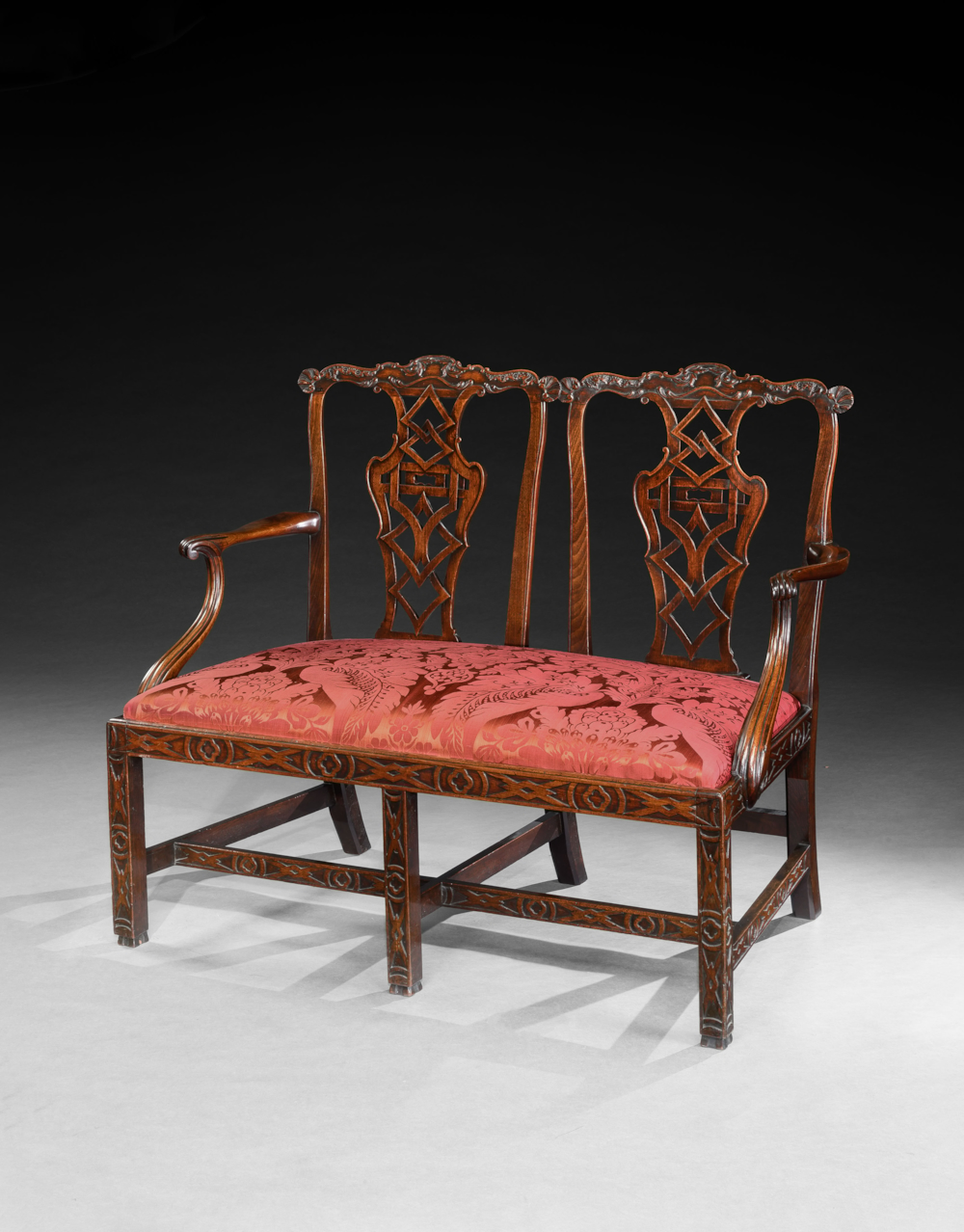
A GEORGE II CHAIRBACK SETTEE
england , circa 1755
A superb George II early Chippendale period carved mahogany chair back settee. The top rail with scrolled acanthus and rocaille carved detail and bordered by shell ears. The two vase shaped splats pierced with interlaced lozenges and frets, and with scrolled arm supports. The seat frame of quatrefoil form with geometric blind fretwork and silk upholstered drop in seat, supported by splayed rear legs and three square section front legs terminating in guttae feet. The legs joined by a blind fret detailed cross stretcher.
Provenance
Private collection, UK
Stock number
AD.435
dimensions
More Details
Height: 28³/₄ in (73 cm)
Width: 44¹/₈ in (112 cm)
Depth: 22⁷/₈ in (58 cm)
Width: 44¹/₈ in (112 cm)
Depth: 22⁷/₈ in (58 cm)
The bold overall design of this superb settee is reminiscent of a number of drawings by Thomas Chippendale which feature across all three editions of his unsurpassed furniture publication, The Gentleman and Cabinet-Maker's Director, 1753-62.
As with much of Chippendale's output during this period, the present settee represents a highly imaginative combination of the three most influential 'styles' then at the height of fashion in England; the 'French' or Rococo; the Chinese; and the 'Gothick'. The scroll, floral, shell and acanthus carved toprail, along with the sweeping scrolled arm supports, are all typical elements of the Rococo style founded in France. Whereas the pierced geometric splat and geometric blind fretwork are indicative of a 'Chinoiserie' influence while the blind quatrefoils to the legs, seat frame and stretchers are strong gothic features.
The carved guttae feet on this settee are a signature detail often associated with the firm of Royal cabinet-makers Vile and Cobb. Inspired by classical architecture, these feet feature small, drop-like or cone-shaped carvings mimicking the 'guttae' found under the triglyphs of a Doric entablature. Documented examples include those on a set of stools supplied by Vile and Cobb in 1753 for the Vyne, Hampshire and on the celebrated suite of carved mahogany seat furniture supplied to the Earls of Shaftesbury for St. Giles, Dorset around 1760.
As with much of Chippendale's output during this period, the present settee represents a highly imaginative combination of the three most influential 'styles' then at the height of fashion in England; the 'French' or Rococo; the Chinese; and the 'Gothick'. The scroll, floral, shell and acanthus carved toprail, along with the sweeping scrolled arm supports, are all typical elements of the Rococo style founded in France. Whereas the pierced geometric splat and geometric blind fretwork are indicative of a 'Chinoiserie' influence while the blind quatrefoils to the legs, seat frame and stretchers are strong gothic features.
The carved guttae feet on this settee are a signature detail often associated with the firm of Royal cabinet-makers Vile and Cobb. Inspired by classical architecture, these feet feature small, drop-like or cone-shaped carvings mimicking the 'guttae' found under the triglyphs of a Doric entablature. Documented examples include those on a set of stools supplied by Vile and Cobb in 1753 for the Vyne, Hampshire and on the celebrated suite of carved mahogany seat furniture supplied to the Earls of Shaftesbury for St. Giles, Dorset around 1760.
 enquire
 +44 (0)20 7839 5671
 +44 (0)7725 332 665


